ARBITER
Local-first dev environment control plane
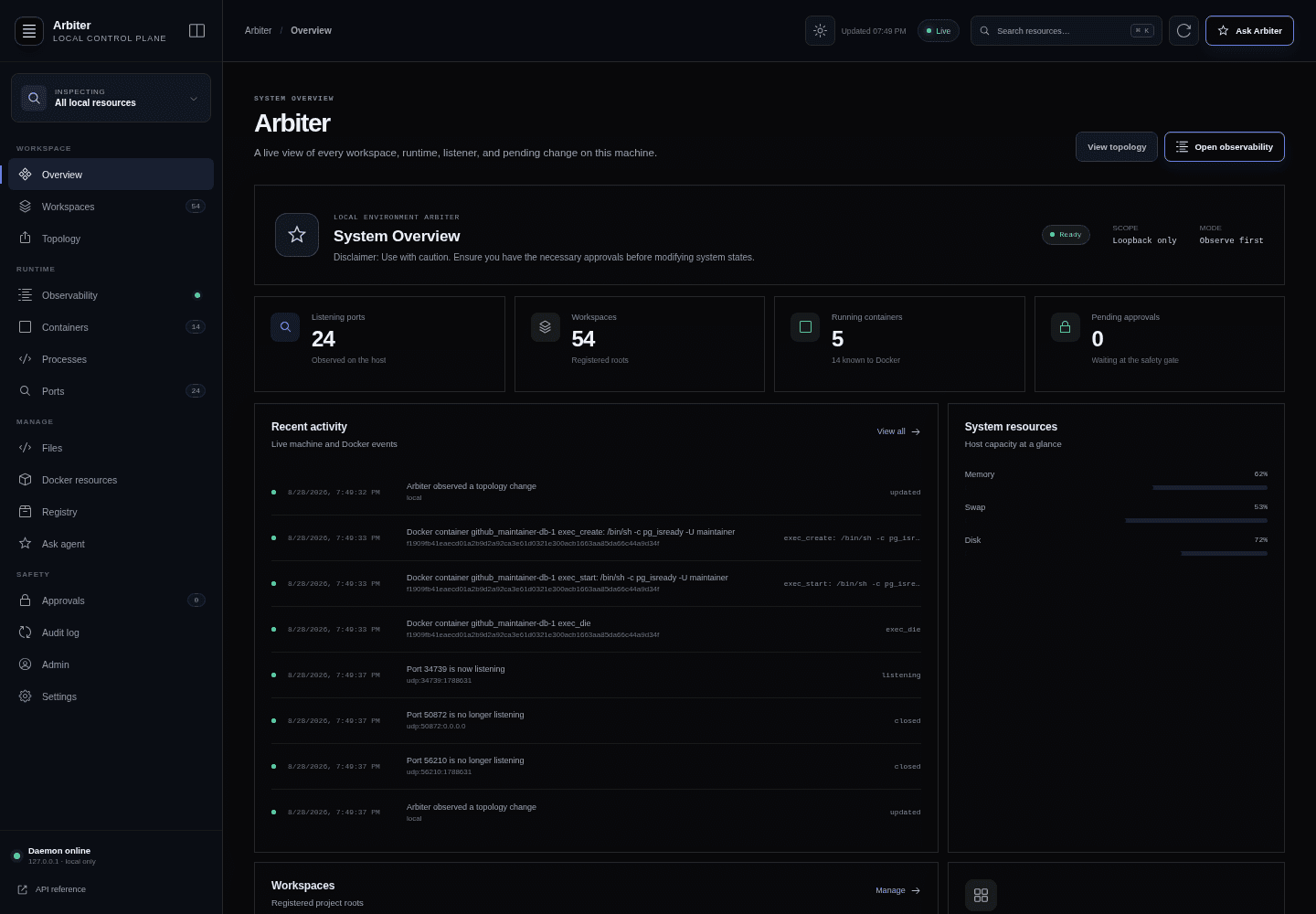
Deterministic port coordination, live workstation topology, and approval-gated SRE control plane for local development.
subjectEXECUTIVE SUMMARY
A developer workstation frequently runs multiple services competing for identical ports (PostgreSQL on 5432, Redis on 6379, frontend servers on 3000/5173, and API servers on 8000). When multiple projects are active simultaneously, identifying which process or container owns a port and safely re-allocating it is error-prone.
Arbiter acts as an embedded SRE operator on your machine. It gathers low-level Linux socket evidence (`ss`) and Docker daemon metadata, renders a live connected resource topology, proposes deterministic replacement ports, requires human approval for state-changing operations, and automatically verifies system health after execution.
Crucially, Arbiter operates under strict safety invariants: no arbitrary shell execution, no unbounded filesystem writes, immutable UUID-tracked approvals in SQLite, and compensating rollback transactions if Compose validation or container recreation fails.
Local development environments are fragile: running multiple microservices or agent-generated Docker Compose stacks results in silent port collisions, orphaned containers, and broken configurations. Developers waste hours tracking down PIDs or manually modifying YAML files with no rollback guarantee.
Arbiter provides a unified control plane that scans Linux `/proc` and socket listeners, maps Docker labels to Compose services, deterministically calculates free replacement ports, and safely rewrites Compose and `.env` files with atomic backups.